Geological Crown of the Czech Republic Geological Crown of the Czech Republic

participants
52
The Geological Crown of the Czech Republic is a hiking challenge focused on exploring the diverse geological structure of our landscape. It connects selected peaks and sites that represent various types of rocks and geological environments of the Czech Republic. The goal is not performance, but the discovery of the story of the land beneath our feet.

GRANITE
Plechý – a deep-seated magmatic rock formed by the slow cooling of magma at depth, very hard and durable, forming the ancient core of the Bohemian Massif.

GNEISS
Praděd – a highly metamorphosed rock with a banded structure, formed from original igneous or sedimentary rocks under high pressure and temperature.

PHYLLITE
Sněžka – a fine-grained metamorphic rock formed from the transformation of clayey sediments, characterized by its flaky cleavage and high susceptibility to erosion.

SCHIST
Lysá hora – a medium-metamorphosed rock with pronounced schistosity, a transition between phyllite and gneiss.

CRYSTALLINE COMPLEX
Králický Sněžník – a mixture of gneisses, schists, and crystalline slates representing deep parts of the Earth's crust.

BASALT
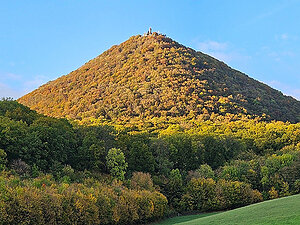
Milešovka – an extrusive volcanic rock formed by the rapid cooling of lava, characterized by its dark color and columnar jointing.

ANDESITE / VOLCANIC TUFFS
Hradiště (Doupovské hory) – volcanic rocks formed by explosive volcanic activity, creating an extensive stratovolcanic complex.

FONOLITE
Klíč – an alkaline volcanic rock with a characteristic conical shape, formed from viscous lava.

SANDSTONE
Děčínský Sněžník – a sedimentary rock composed of cemented quartz grains, forming table mountains and rock cities.

DOLOMITE / LIMESTONE
Děvín (Pálava) – carbonate rocks with a high magnesium content, creating thermophilic and steppe biotopes.

FLYSH
Velká Čantoryje – alternating sandstones and claystones deposited in a deep sea, typical for the Carpathian mountains.

TUF
Říp – fine-grained sedimentary rocks formed from marine muds, easily weathered, a symbol of the Czech landscape.

LOESS / QUATERNARY SEDIMENTS
Hády (Brno) – unconsolidated sediments blown by the wind during the Ice Age, documenting the young geological history.

QUARTZITE
Plešivec (Brdy) – an extremely hard metamorphic rock formed from sandstone, very resistant to erosion.

SILICITE
Radyně – ancient deep-sea silicate, extremely hard, forming prominent ridges with very dark to black rock outcrops.
Sněžka
1603 m n.m.
1197 m
Praděd
1491 m n.m.
983 m
Plechý
1378 m n.m.
508 m
Hradiště
934 m n.m., optional
279 m
Klíč
760 m n.m.
208 m
Plešivec
654 m n.m.
181 m
Radyně
567 m n.m.
92 m
Děvín
550 m n.m.
348 m
Říp
461 m n.m.
240 m
Hády
425 m n.m.
8 m
Share