


Hiking, 14 km
26.9.2023
 Indonésie
Logged on Vrcholovka 13x in total. Vrchol Gunung Ijen was added here by Jirka Hruška and info was completed by Jirka Hruška.
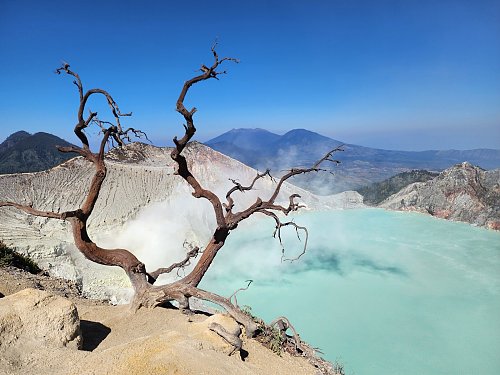
The UNESCO Global Geopark Ijen, located in East Java, Indonesia, boasts natural beauty and is known for its volcanic landscape, unique geological formations, and cultural heritage. It includes Mount Ijen, a stratovolcano with a picturesque turquoise crater lake known as Kawah Ijen, which is the most acidic lake in the world, as well as the Belambangan biosphere reserve, designated by UNESCO in 2016.
The UNESCO Global Geopark Ijen features a high concentration of volcanic cones, craters, and lava flows that showcase the complex geological processes that have shaped the region over millions of years. The main attraction of the geopark is the Ijen volcano and its lake, known as the most acidic lake in the world, and its otherworldly phenomenon of blue fire – a rare occurrence caused by ignited sulfur gases that emerge from cracks in the crater. Ijen is one of the most active volcanoes in the Ijen caldera system. Approximately 22 post-caldera volcanic cones have formed inside and on the edge of the caldera. This volcanic activity rises above limestone bedrock and tertiary volcanic rock, which are found as ancient hills 50 km south of Ijen.
The Ijen crater lake is a remarkable natural feature influenced by a range of geological processes. It contains chemical solutions formed by the interaction of magmatic volatiles, interactions between rocks and fluids, evaporation, dilution by meteoric water, and recirculation of water through subsurface hydrothermal systems. The lake acts as a condenser of volatile water from shallow magmatic heat sources and assimilates acidic magmatic vapors, leading to the formation of highly acidic water.
Notably, the Ijen crater exhibits the characteristic phenomenon of blue fire, attributed to the reaction between sulfur and oxygen. While most volcanoes produce red or orange flames, the high concentrations of sulfur and temperatures exceeding 360 °C in the Ijen crater create a unique environment for the formation of blue fire. This phenomenon is only observable at night due to the intense sunlight that obscures the visibility of the blue flames.
There is no chalet on the peak.
Peak is not stroller accessible.
There are views from the peak.
There is no cable car to this peak.
a gas mask is required for descending into the crater
entrance fee approximately 100,000 IDR
Nearest peaks: Gunung Ijen J (2380 m, 0.9 km) Gunung Merapi Ijen (2803 m, 1.6 km) Gunung Madipuneng (2158 m, 2 km) Gunung Pawenan (2180 m, 2 km) Gunung Widodaren (2146 m, 2.1 km) Gunung Papak (2141 m, 2.4 km)
| today | tomorrow | day after tomorrow | |
|---|---|---|---|
| Dawn: | 4:34 | 4:34 | 4:33 |
| Sunrise: | 4:56 | 4:55 | 4:55 |
| Sunset: | 17:17 | 17:17 | 17:18 |
| Dusk: | 17:39 | 17:39 | 17:39 |