Chan Tengri (7010 m a.s.l., Ťan-šan)
Register and log summit

About peak Chan Tengri
 Kyrgyzstán
Vrchol Chan Tengri was added here by Milan "Hojší" Průžek and info was completed by Milan "Hojší" Průžek, Martin Horáček a Martin Matějka.
Chan Tengri is part of challenge: Snow Leopard
The height data varies. Some sources claim 6995 meters, others 7010.
Chan Tengri (Russian: Хан-Тенгри, Kyrgyz: Хан-Теңири, Kazakh: Хан Тәңірі, Chinese: 汗腾格里峰, pinyin: Hán-téng-gé-lǐ-fēng, Czech transcription: chan-tcheng-ke-li-feng, translated as Lord or Ruler of the Heavens, also referred to as Kan-Tau from the Kazakh Қантау, Қантоо, meaning blood mountain due to the reddish color of the summit rocks) is the highest mountain in Kazakhstan at 6995 m above sea level (7010 m with the summit glacier) and the second highest peak of the Central Asian Tian Shan mountain range. It is located in the southeast of the country on the border with Kyrgyzstan and is often considered the northernmost seven-thousander. Due to its shape of a relatively regular pyramid, this mountain is among the most impressive peaks in the world and is sometimes referred to as one of the most beautiful mountains in the world.
Although the summit is over 400 meters lower compared to the nearby Jengish Chokusu, it was long considered the highest peak of the Tian Shan, even five years after both peaks were first ascended.
The summit was reportedly known to ancient travelers. The first European to see the summit was the Russian geographer and traveler Petr Petrovich Semenov-Tian-Shansky during an expedition in 1856-1857. His description of the central Tian Shan attracted the attention of many other travelers, researchers, and climbers to the area. Expeditions to the central Tian Shan were then undertaken in 1864 by Nikolai Alexeyevich Severtzov, in 1869 by Alexander Vasilievich Kaulbars, in 1876 by Alexei Nikolayevich Kuropatkin, and ten years later by Andrei Nikolayevich Krasnov. The area was bustling at the turn of the 19th and 20th centuries, when in 1900 a Hungarian expedition of zoologists led by Gyorgy Almáshi and Rudolf Stummer von Traunfels operated here, and in the same year Italians Scipione Borghese and Jules Brocherel. In 1902, Vasilij Vasilievich Sapožnikov measured the height of the summit at 7193 m above sea level, and the first ascent attempt was made unsuccessfully by the German climber and geographer Gottfried Merzbacher.
Climbers returned to the summit only at the end of the 1920s. In 1929, an expedition from the Ukrainian Academy of Sciences with a climbing section led by Mikhail Timofeyevich Pogrepeckiy attempted the summit unsuccessfully. Two years later, Pogrebeckiy returned at the head of a new expedition to the central Tian Shan and on September 11, 1931, together with Boris Tyurin and Franz-Joseph Zauberer, reached the summit via the southern route and the western ridge. This route is now the normal ascent route from the south.
The summit was again reached in 1936 by a group led by Yevgeny Kolokolnikov. In 1943, topographic mapping was conducted in the area, during which the height of Chan Tengri was measured at the currently reported value of 6995 meters, and at the same time the height of Peak Pobeda was measured at 7439 meters. Chan Tengri, previously considered the highest peak of the Tian Shan, thus lost this title. Climbers returned to Chan Tengri again only in 1954, when the mountain was first ascended from the north by a group led by Vladimir Shipilov. This ascent received 2nd-3rd place in that year's USSR Mountaineering Championship in the high-altitude ascent category. Since the 1960s, there have been 23 more first ascents (new route ascents) on Chan Tengri, three of which won first place in the USSR Mountaineering Championship: in 1964, the ascent from the north by Kirill Kuzmin's group and the ascent of Boris Romanov's group via the Marble Ridge from the south (joint first place); in 1974, the ascent of the northern wall by Eduard Myslovsky's group.
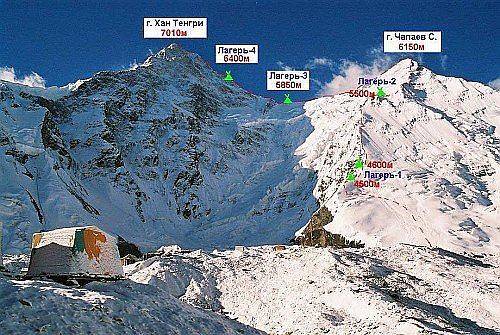
On August 5, 2004, a massive avalanche was released from the slope of Mount Chapayev, under which the southern normal route to Chan Tengri leads between high camps C2 and C3 (approximately 5000 m above sea level), killing five Czech and one Russian climber. In 2013, a young Polish climber Artur Kozlowski (24 years old) became infamous on Chan Tengri for not adhering to safety and moral principles of high-altitude climbing. He was last seen at the end of July 2013 in C3 in a tent belonging to a Czech expedition. To this day, his body has not been found.
- Chalet/accommodation
-
There is no chalet on the peak.
- Stroller access
-
Peak is not stroller accessible.
- Views
-
There are views from the peak.
- Cable car
-
There is no cable car to this peak.
- Equipment
-
Special equipment is required for this summit.
- Accessibility
Nearest peaks: Pik Peťki (6120 m, 2.5 km)
Sun
| today | tomorrow | day after tomorrow | |
|---|---|---|---|
| Dawn: | 6:39 | 6:40 | 6:41 |
| Sunrise: | 7:08 | 7:09 | 7:10 |
| Sunset: | 17:37 | 17:36 | 17:34 |
| Dusk: | 18:06 | 18:05 | 18:03 |