Puncak Trikora (4730 m a.s.l., Maoke)
Register and log summit
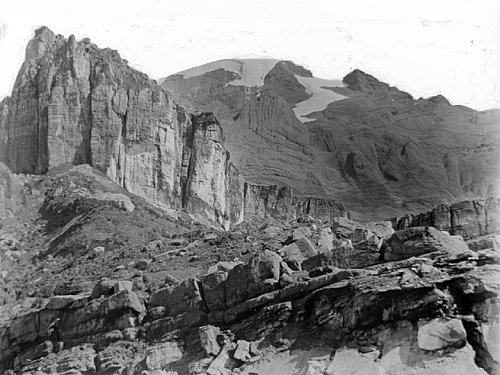

About peak Puncak Trikora
 Indonésie
Vrchol Puncak Trikora was added here by Jirka Hruška and info was completed by Jirka Hruška.
Puncak Trikora (literally "Peak of the People's Tri Command") is the third highest mountain on the island of New Guinea and in all of Oceania.
The Dani people living near Lake Habbema call the mountain Ettiakup. Around 1905, the mountain was named after the Dutch Queen Wilhelmina. When Indonesia gained control over Western New Guinea in 1963, the name was changed to Puncak Trikora after the Trikora speech (Tri Komando Rakyat "People's Tri Command") delivered by Sukarno in December 1961 at a mass rally in Yogyakarta. The three commands were: to prevent the emergence of an independent state of West Papua, to raise the Indonesian flag in this land, and to be ready for mobilization at any time.
At the beginning of the 20th century, all the highest mountains of New Guinea, including Puncak Jaya (Carstensz Pyramid), Puncak Mandala (Juliana Peak), Ngga Pilimsit (Idenburg), and Puncak Trikora (Wilhelmina Peak), were covered with glaciers. The first expeditions to the Maoke range documented a significant recent retreat of all glaciers in the area. The glacier cap of Puncak Trikora melted between 1936 and 1962. In 1909, the glacier cap still reached an elevation of just 4400 m.
Thanks to the navigable Noord River, the mountain was more accessible than other snow-capped peaks of Dutch New Guinea, and the Dutch organized a series of scientific expeditions in the early 20th century to reach the equatorial eternal snow and conquer the mountain. The leader of the first two expeditions was diplomat and amateur biologist H. A. Lorentz. Each expedition was accompanied by soldiers, porters, and Dayaks, who were employed for their expertise in boat navigation.
In July 1907, the first expedition established Camp Alkmaar near the point where the Noord River, known as the Lorentz River since 1910, became unnavigable (4°40′ S, 138°42′ E), but failed to penetrate the highest range. The second expedition to southern New Guinea also used Camp Alkmaar, departing on October 9, 1909. On November 8, a group of nine people, including Lorentz and Jan Willem van Nouhuyse, reached the first eternal snow of New Guinea at an altitude of 4460 m. From the ridge, they observed a large lake to the north, which Lorentz named Lake Habbema (4°08′ S, 138°40′ E) after one of the expedition members. They did not attempt to reach the summit of Wilhelmina. The return journey was challenging; with the loss of four expedition members, the explorers finally returned to Camp Alkmaar in mid-December.
The summit was first reached in 1913 during the third expedition to Southern New Guinea, which lasted from September 1912 to April 1913 and followed the same route. It was led by Alphons Franssen Herderschee, an officer of the Royal Dutch East Indies Army, and aimed to research the soil, flora, and fauna of the region above 2300 meters. Other members of the expedition included zoologist Gerard Martinus Versteeg, botanist August Adriaan Pulle, geologist Paul François Hubrecht, and JB Sitanala, an Indonesian general practitioner. Herderschee also took on the role of ethnographer. The baggage train, including soldiers, porters, and Dayaks, had 241 members. They were divided into several groups to perform various tasks efficiently. Herderschee, Hubrecht, and Versteeg formed the summit team that reached the Wilhelmina summit on February 21, 1913.
The expedition to Central New Guinea from 1920 to 1922 aimed to reach the mountain from the northern coast via a route partially explored during a military expedition in 1914. The first exploratory expedition led by AJA van Overeem began on February 7, 1920, at the mouth of the Mamberamo River and followed the Idenburg River. In October, the expedition crossed the Doorman Mountains and reached the upper Swart Valley (now Toli Valley). Here, they made first contact with the Lani tribe (also known as Western Dani), an agricultural tribe, with whom they stayed for six weeks. Due to running out of time and food supplies, the expedition returned without summiting Wilhelmina.
A subsequent expedition, which began in June 1921 and was led by JHG Kremer, who had been a geodet the previous year, retraced the route and reached the summit on December 4, 1921, via the upper Baliem Valley and Lake Habbema. Among the climbers was Paul Hubrecht, who had been at the summit in 1913 and noted that the ice cap had significantly retreated over the previous 8 years.
- Chalet/accommodation
-
There is no chalet on the peak.
- Stroller access
-
Peak is not stroller accessible.
- Views
-
There are views from the peak.
- Cable car
-
There is no cable car to this peak.
- Equipment
-
Special equipment is required for this summit.
- Accessibility
-
Special permit required.
Nearest peaks: Puncak Sinakma (4091 m, 3.1 km)
Sun
| today | tomorrow | day after tomorrow | |
|---|---|---|---|
| Dawn: | 5:00 | 5:00 | 5:00 |
| Sunrise: | 5:21 | 5:21 | 5:21 |
| Sunset: | 17:36 | 17:36 | 17:36 |
| Dusk: | 17:57 | 17:57 | 17:57 |